
Court-Admissible DNA Tests vs. At-Home Kits: What Is the Real Difference?
Meta description: At-home DNA kits and court-admissible tests are not the same thing. Here is what sets them apart and how to know which one you actually need.
Target keyword: court admissible DNA test vs at home kit
Category: DNA Testing Basics
Internal links to add: Paternity Testing page, What Is DNA Testing post, Contact/Schedule page
At-home DNA kits are everywhere now. You can order one online and have it at your door within a day or two. They are affordable, private, and for some situations, they are exactly what you need.
But if there is any chance you will ever need your results to hold up in a legal setting, an at-home kit will not work. Not because the science is less accurate, but because of something that has nothing to do with the lab at all. Understanding that difference before you test can save you from paying twice and starting the process over under stressful circumstances.
The Science Is Not the Problem
Both at-home kits and professionally collected tests send samples to a laboratory for analysis. In many cases, the lab doing the analysis is the same, or the technology is equivalent. The DNA science itself does not differ in any meaningful way between the two.
Accuracy rates for paternity testing are high across the board. A confirmed match typically comes back at 99.9% or above. An exclusion is 100% conclusive. This holds true whether the sample was collected at home or in a clinical setting.
So if the science is the same, what is the difference? It comes down entirely to how the sample is collected and documented.
What Chain of Custody Actually Means
Chain of custody is a legal term that refers to the documented, unbroken record of who collected a sample, how it was handled, and how it moved from the person being tested to the laboratory. Every step is recorded and verified by a neutral third party.
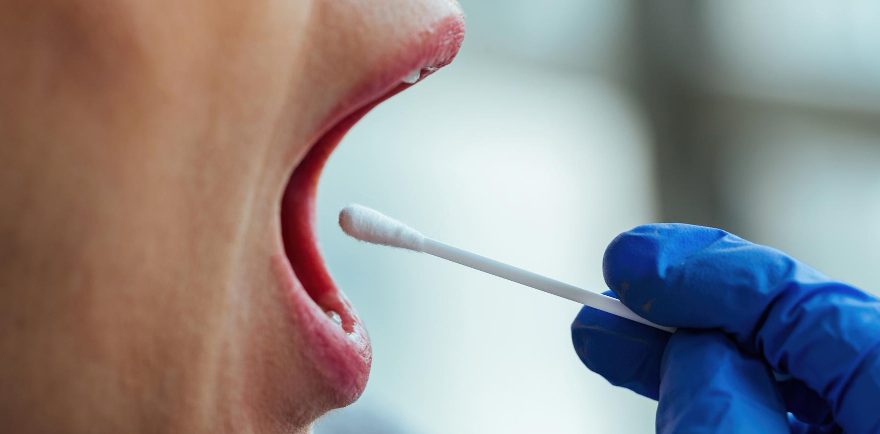
For a DNA test to be court admissible, the collection process has to meet this standard. Here is what that looks like in practice. The people being tested must show government-issued photo identification to confirm they are who they say they are. A trained, neutral collector witnesses the sample collection in person. The samples are then sealed, labeled, and documented immediately, with signatures from everyone present. That documentation travels with the sample to the lab and becomes part of the final report.
The reason courts require this is straightforward. Without a verified chain of custody, there is no way to prove that the person who provided the sample is actually the person named in the test. Someone could theoretically collect a sample on behalf of another person, swap samples, or tamper with the collection process. Chain of custody closes all of those possibilities.
An at-home kit has none of these safeguards. You collect the samples yourself, seal the package yourself, and mail it in. The lab has no way to verify who actually provided the sample. The results may be accurate, but they cannot be authenticated, and a court will not accept them.
When You Need a Court-Admissible Test
If any of the following apply to your situation, you need a legally admissible test rather than an at-home kit.
You need a court-admissible test if paternity is being established for a birth certificate. In most states, if an unmarried father is not listed on the birth certificate, a legal paternity test is required to add him later.
You need a legal test if child support is involved. Courts will not base a child support order on results from an at-home kit.
You need a legal test if custody or visitation rights are being determined. Any family court proceeding that hinges on biological parentage will require results collected under proper chain-of-custody documentation.
You also need a legal test for immigration cases. The U.S. Citizenship and Immigration Services requires AABB-accredited laboratory results with verified chain-of-custody documentation when DNA is used to establish a biological relationship for immigration purposes.
Finally, if the test involves an estate dispute or inheritance claim, legal results are required.
When an At-Home Kit Is Actually Fine
At-home kits are appropriate when you need to know the answer for personal reasons and do not anticipate any legal use for the results.
If you simply want confirmation for your own peace of mind, and the results will stay between the people involved, an at-home kit can give you an accurate answer at a lower cost. Many people use them exactly this way, and that is a legitimate use.
The problem arises when people start with an at-home kit thinking it will be enough, and then find themselves in a legal situation later. At that point, the original results cannot be converted into a legal document. A new test has to be done from the beginning, under proper chain-of-custody protocols. This means paying for a second test and restarting the process entirely, often while dealing with an already stressful legal situation.
If there is even a small chance you may need results legally at some point, it costs less in the long run to do the legal test from the start.
What to Look for in a Legal DNA Test Provider
Not every testing provider offers legally admissible collection, so it is worth knowing what to ask before you schedule.
The laboratory processing your sample should be AABB-accredited for relationship testing. The American Association of Blood Banks sets the standards for DNA paternity and relationship testing, and accreditation means the lab has been independently verified to meet those standards. You should be able to ask your provider which lab they use and confirm accreditation directly.
The collection should be performed by a trained, neutral third party, not by the people being tested or anyone connected to them. Some providers have their own collection staff. Others work with a network of qualified collectors at clinics and medical offices. Either can work as long as proper documentation is completed.
You should also receive a report that includes the chain-of-custody documentation alongside the DNA results. If a provider cannot tell you clearly how their collection process works or what documentation you will receive, that is worth paying attention to.
The Most Common Mistake We See
The most common situation we hear about is someone who purchased an at-home kit, got a result, and then discovered they needed that result for court. Sometimes the paternity situation became contested. Sometimes child support proceedings started unexpectedly. Sometimes a legal matter came up that nobody anticipated when the test was first taken.
The result sitting on their phone or in their email is accurate. But it is unusable for their actual need, and the process has to start over.
Asking one question before you test can prevent this entirely: is there any situation, now or in the future, where I might need these results to be legally recognized? If the answer is yes, or even maybe, choose the legal route.
Bottom Line
The DNA science in at-home kits is real. The accuracy is real. What is missing is the documentation that makes results trustworthy to a court. That documentation is not a technicality. It is the entire basis for why results can be used in legal proceedings.
If you are not sure which type of test fits your situation, we are happy to walk you through it before you make any decisions.
Sources:
American Association of Blood Banks (AABB), Relationship Testing Program: aabb.org
U.S. Citizenship and Immigration Services, DNA Evidence: uscis.gov
Clinical Laboratory Improvement Amendments (CLIA): cms.gov/clia